Emma by Jane Austen
Book Rating 3.5 / 5 - A fun romance featuring the same few characters.
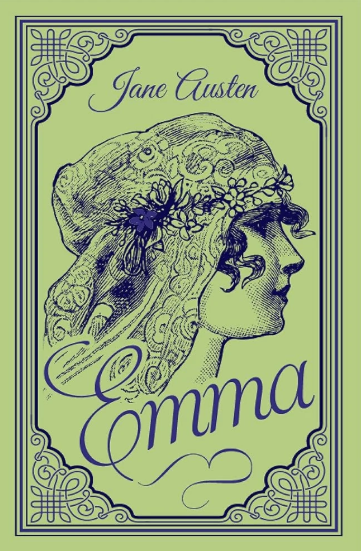
I somehow have been influenced to read many classic novels. Since discovering my love of The Count of Monte Cristo, I have been thrown into the deep end of literary classics. If only such adoration and enjoyment of these works had happened when I was required to read them for class, things would have been much more enjoyable during my degree. I bought Emma by Jane Austen many years ago. With the publishing company, Paper Mill Press having sold many classic novels for very cheap, with very pretty covers. It was so affordable that I bought it intending to read it. I got maybe 20 pages in before I closed the book and didn’t pick it up for another 2-3 years.
At the time of my first reading attempt, the words and dialect of Austen’s time didn’t click with me. It was too confusing, I continued to get lost on what was going on. But I decided to pick it back up about a month ago (which is why this book of the week review is so late). It did take me some extra time due to the fact I am halfway through another book to review, but I invested the last week solely reading the last half of this novel. During this second read, the words clicked better, I understood and could enjoy the language of the Regency period. Which ultimately helped me truly dive into this novel and finish it. Now on to my review.
Emma by Jane Austen centers on the titular character, Emma Woodhouse. An upper-class twenty-one year old, who lives with her father Mr. Woodhouse in their elegant, yet smaller, estate. They aren’t noble, but merely financially comfortable due to the income they earn on their lands. Their close neighbor, Mr. Knightley is a close family friend who is close with both Emma and her father. Who is more wealthy, not noble, and lives in the large estate Donwell.
Emma from the very start of the book, is a self proclaimed match-maker and prides herself on combining unsuspecting family friends together in marriage. Such bonds came together such as her prior governess, Miss. Taylor and family friend Mr. Weston. and Mr. Knightley’s younger brother with her elder sister. Life, however, can be lonely for Miss. Woodhouse at Hartfield. That is until she meets Harriet Smith, a girl who lives at the town’s boarding school for young ladies. Upon meeting, Harriet is very eager to please Emma, and tends to follow her influences which Emma indulges and enjoys. Romantic drama ensues with Emma influencing Harriet’s attempts and offers of marriage from reoccurring gentlemen within the story. As well as her irritation over the arrival of a frenemy, Jane Fairfax. As old, beautiful, and elegant as Emma (which of course displeases her). Throughout the 500 pages, we come across the same few characters. The Elton’s, the Bates’s, the Weston’s, the Churchills, the Knightley’s, the Woodhouse’s, and the Martin’s. Which I find to be really enjoyable. Realistically, too many characters would have complicated the story and made the impact of the ending less special. With a limit on the characters we know, each plot is connected, each crush developed and then broken is all in the same social circle, and the dynamics between the characters is that of familiarity and comedy. We all know, of course, that Mr. Knightley and Emma end up together. Which happens no less than 30 pages before the end of the novel! Where most of the romantic words of affirmation between these two is actually exchanged. In fact, most of the stories meat is of the trials and tribulations of Emma’s blunders, her character development from local snob to friend to all, and her dynamic between her and one Frank Churchill. Despite the fact the romance aspect of this novel happens in the last hour of the story, it actually still feels quite rewarding. Mr. Knightley, I argue, is second to Jane Austen’s romantic leads right behind Mr. Darcy.
Mr. Knightley doesn’t entertain Emma’s outlandish schemes, nor a moment where she is particularly cruel to the talkative Miss. Bates. They bicker and fight unlike many regency stories between leads where their arguments don’t lead to steamy kisses. Mr. Knightley forces Emma to reflect on her behaviors and correct them without taking away her power or autonomy over them. Which I appreciated in this novel where we can see the importance the two has for the others opinions. They are so close throughout the story, that love is a fun and gentle reward in the end. With the (obvious) reveal they the wo had always loved each other for quite some time. I will add, however, I face-palmed when right at the end of the story, Knightley confides to Emma that he had loved her since she was thirteen, when he would have been around twenty-nine… Jane, why did we have to say that?
HOWEVER, at the time of the story, Emma is twenty-one and Knightly is around thirty-seven. Which means there is a sixteen year age gap between them. As someone in an age gap relationship currently (which is less than sixteen), I am not particularly offended by this as Emma is 21, which in my opinion is the minimum age one should be in an age-gap relationship, and Knightley is still under forty (my max for a comfortable age gap in this scenario). The bond they share is obviously one of respect, not one of coercion or a constant reminder of their age and power imbalance in society. They had always been honest and considerate of each other, which is why the age-gap ultimately, was not a pressing issue for me.
Overall, I give Emma by Jane Austen a 3.5 out of 5. I am happy to have finally read this book I bought so many years ago, and even more happy to finally be able to say I read it. The book can be a bit of a drag at times, which gives it the lower score. As most of the juicy plot unfolds in the last 200 pages, and before that much of the novel seems to drone on for a bit too long. The characters are charmingly funny and pointed, which makes for an engaging read. The language, of course, still takes getting used to which is another reason for point deduction. As many probably wouldn’t enjoy reading that language unless you craved such diction within literature. I was happy to read Emma, and I am also happy to have finally finished it. It’s a lovely read for Jane Austen lovers, regency period watchers, and literary classic indulgers.
